my oldest son received this book as a gift when his baby brother & sister were born almost 2 years ago. (my oldest daughter got a sisters book) I love reading this to my kids and talking about the animals.
do you have this book?
Showing posts with label Good Reads. Show all posts
Thursday, May 5, 2011
Tuesday, March 29, 2011
The Guernsey Literary and Potato Peel Pie Society
I didn't have any expectations when I opened the first page of The Guernsey Literary and Potato Peel Pie Society by Mary Ann Shaffer and Annie Barrows. I'd heard of it, sure, but I didn't know a thing about it.
And that name. It's just weird. I wasn't sure what to make of it.
The book begins with a letter.
Hmmm, I thought. I still wasn't intrigued.
But then I read the letter. And the next one. And the next. And all through the book I found myself being drawn into these lives. I saw the places, I felt the feelings. Like many good books, it took me to a place I'd never been and made me feel as if I'd been there and would welcome a return.
The story centers around Julie Ashton, a London-based writer who leaves the city to visit Geurnsey farmers who've been writing to her. As she gets to know these strangers who've endured Germany's occupation, she learns about them, and she learns about herself. I admit: the story pulled me in.
Although this isn't the kind of book I tend to gravitate towards (East of Eden, A Fine Balance), I really enjoyed it. Thumbs up, friends. Give it a read!
And that name. It's just weird. I wasn't sure what to make of it.
The book begins with a letter.
Hmmm, I thought. I still wasn't intrigued.
But then I read the letter. And the next one. And the next. And all through the book I found myself being drawn into these lives. I saw the places, I felt the feelings. Like many good books, it took me to a place I'd never been and made me feel as if I'd been there and would welcome a return.
The story centers around Julie Ashton, a London-based writer who leaves the city to visit Geurnsey farmers who've been writing to her. As she gets to know these strangers who've endured Germany's occupation, she learns about them, and she learns about herself. I admit: the story pulled me in.
Although this isn't the kind of book I tend to gravitate towards (East of Eden, A Fine Balance), I really enjoyed it. Thumbs up, friends. Give it a read!
Thursday, March 24, 2011
good bedtime reading
Every night we read to our kids as part of our bedtime routine. A couple of my favorites to read with my younger ones are Good Night Gorilla & Pajama Time.
My 20 month old twins just love it. My little E is the most into it, he loves to find the banana with each turn of the page, and gets excited to see the all black pages with just the wife's eye balls. Just the other night my little A noticed the yawning gorilla so we now do an exaggerated yawn. So much fun and different things to notice each time in the last 6 years since we got this book.
Reading is one of my favorite bonding times. Have fun reading to your kids.
My 20 month old twins just love it. My little E is the most into it, he loves to find the banana with each turn of the page, and gets excited to see the all black pages with just the wife's eye balls. Just the other night my little A noticed the yawning gorilla so we now do an exaggerated yawn. So much fun and different things to notice each time in the last 6 years since we got this book.
Pajama Time is such a fun book too. One that was given to my older kids from their nanny (a now 2nd grade teacher.) I sing it to a tune and we do movements and then I love the "Hop into bed. Turn out the lights...." After this book is over we say good night to our books as we put them away. I turn out the lights and then place them in their cribs.
Reading is one of my favorite bonding times. Have fun reading to your kids.
Thursday, February 24, 2011
Scary Monsters Banished!
There is that saying that a picture is worth 1000 words. I've heard also that it takes actually 4000 words to equal the impact of one image.
When your kids are scared of monsters, this book speaks volumes.
Go Away, Big Green Monster by Ed Emberley helped my oldest child when she was having bad dreams about monsters.
The book is interactive, as each page is turned the monster appears, then as the child tells him to "GO AWAY" each page turned makes another part of the monster disappear.
My daughter loved that. We borrowed the book, and read it over and over each time we did. Makes me wish we'd bought it. As my youngest is still 2 1/2 I still may invest in this book because it is just that invaluable for helping kids through the scary monster faze.
What books have helped your kids through fears?
When your kids are scared of monsters, this book speaks volumes.
Go Away, Big Green Monster by Ed Emberley helped my oldest child when she was having bad dreams about monsters.
The book is interactive, as each page is turned the monster appears, then as the child tells him to "GO AWAY" each page turned makes another part of the monster disappear.
My daughter loved that. We borrowed the book, and read it over and over each time we did. Makes me wish we'd bought it. As my youngest is still 2 1/2 I still may invest in this book because it is just that invaluable for helping kids through the scary monster faze.
What books have helped your kids through fears?
Thursday, February 17, 2011
The Great Gracie Chase
I just love this book! When I read with my kids, The Great Gracie Chase one of my go-to favorites. It's a sweet story that's easy to read, with just a touch of mischief. How can you resists a little mischief?
If you haven't read it with your kids yet, I definitely recommend Gracie!
Thursday, January 20, 2011
Calm Down, Boris!
D, my 2-year-old has never been one to sit to hear a book. At most, we can get 4 pages read if the sentences are very short or the pages have only a few words. There are 3 books that she will sit for the whole book. Two of the books are by Sandra Boynton (Snuggle Puppy and Moo Baa La La La)...and that is just a testament to what a great children's author she is. If you haven't added Boynton's books to your toddler's library run, don't walk, to the bookstore and get several.
D sits for books that encourage action. Funny noises, animals to name, and songs to sing encourage D to sit for a book (or at least stand nearby where she can still listen and jump if need be!).
I found this book by chance when I visited our local Sam's Club last Summer when they offered a "free day" to come in and check it out. We were members several years ago but ended our membership when it didn't seem like the membership fee offset our savings (mostly I spent too much when I went there).
It's a book and a puppet in one and offers all the things necessary to keep D's attention for reading.
In Calm Down, Boris! Boris is an exuberant and loving monster who just wants to share the love...but his hairy face is a little tickly when he kisses. I love to hear D's giggles when we read this one.
D sits for books that encourage action. Funny noises, animals to name, and songs to sing encourage D to sit for a book (or at least stand nearby where she can still listen and jump if need be!).
I found this book by chance when I visited our local Sam's Club last Summer when they offered a "free day" to come in and check it out. We were members several years ago but ended our membership when it didn't seem like the membership fee offset our savings (mostly I spent too much when I went there).
It's a book and a puppet in one and offers all the things necessary to keep D's attention for reading.
In Calm Down, Boris! Boris is an exuberant and loving monster who just wants to share the love...but his hairy face is a little tickly when he kisses. I love to hear D's giggles when we read this one.
Thursday, September 2, 2010
Homeschool or Public School? A book review.
Over the last 4-5 years I have wondered if I had the stuff to be a homeschooling mother. Most of the time my honest answer with myself is a resounding "no" but that doesn't make me stop toying with the idea. I miss my kids when they're gone at school. Homework is a frustratingly repetitive activity and I know it's only going to get worse. I can't for the life of me figure out why the kids have to do homework when they've just spent 6 hours at school working. Most of the homework is just busy work anyway.
My intrigue about homeschooling was peaked a bit more after I read a book about a mom who took one of her children out of public school for a single year and home schooled her for that year. Her daughter was in 5th grade when she interrupted her public education, and her daughter was extremely frustrated with homework. She was a free-spirited child who loved nature and dreaming...probably like most kids until they get beat down by homework.
I read Love in a Time of Homeschooling: A Mother and Daughter's Uncommon Year
when the publisher sent it to me to review. So full disclosure: I got the book for free. But I really found the book fascinating, and can really see the benefits and drawbacks of both public education and homeschooling. The thing I found most comforting about this book is that this parent recognized what one of her children needed to be able to go on with her education. She needed a year of exploring her own interests in depth and in her own way. She also recognized that her other two children were perfectly happy and thriving in public school.
So that is what I really got out of this book. I know, for now, my kids are thriving and content where they are, but I now know that if that changes, I have options and I won't be afraid to use them.
My intrigue about homeschooling was peaked a bit more after I read a book about a mom who took one of her children out of public school for a single year and home schooled her for that year. Her daughter was in 5th grade when she interrupted her public education, and her daughter was extremely frustrated with homework. She was a free-spirited child who loved nature and dreaming...probably like most kids until they get beat down by homework.
I read Love in a Time of Homeschooling: A Mother and Daughter's Uncommon Year
So that is what I really got out of this book. I know, for now, my kids are thriving and content where they are, but I now know that if that changes, I have options and I won't be afraid to use them.
Thursday, May 27, 2010
What my kids are reading.
I was a major bookworm as a kid. Seriously, I even have this friend from elementary school that I reconnected with as adults, and she has these memories of coming over to ask me to play and I'd always say no because I was reading something, which didn't really compute with her. But anyway, Deoxyribonucleic acid ain't just a spelling bee word, because my nine year old son is not just an avid reader, he's a vacuum. He hoovered his way through all seven books of the Harry Potter series last summer -in about 8 weeks total.
I was both overjoyed and suddenly panicky when I realized that summer that his reading appetite was so voracious. It was glorious to see him so excited to get a new book, or reach a new chapter, or understand a new character being developed. I worried at first that some of the themes were a little too dark for an eight year old, and educators may say Erickson's theory would agree, but he handled it pretty well and we talked it through when needed. But then there was a little warning lamp that started glowing in the back of my brain - Uh oh, what's he going to read next? After book seven, what I am going to feed the beast? We can't exactly go back to Encyclopedia Brown now.
So one afternoon I swung by the school librarians desk. She gave me a whole list of books and authors appropriate to age and reading level, especially for boys who like series.
Before I start listing them here, let me just point out that the school librarian is the most undervalued warm body in the entire building of most elementary schools. They do not just obsess over the Dewey Decimal system, they know everything about what your child should, could, or would read. Seek them out whenever you can.
Anyway, a not very comprehensive but good jumping off place for boys (and some girls may like these, too, I don't know, I only have boys) in 3rd-5th grades who enjoy series books with modern characters:
I was both overjoyed and suddenly panicky when I realized that summer that his reading appetite was so voracious. It was glorious to see him so excited to get a new book, or reach a new chapter, or understand a new character being developed. I worried at first that some of the themes were a little too dark for an eight year old, and educators may say Erickson's theory would agree, but he handled it pretty well and we talked it through when needed. But then there was a little warning lamp that started glowing in the back of my brain - Uh oh, what's he going to read next? After book seven, what I am going to feed the beast? We can't exactly go back to Encyclopedia Brown now.
So one afternoon I swung by the school librarians desk. She gave me a whole list of books and authors appropriate to age and reading level, especially for boys who like series.
Before I start listing them here, let me just point out that the school librarian is the most undervalued warm body in the entire building of most elementary schools. They do not just obsess over the Dewey Decimal system, they know everything about what your child should, could, or would read. Seek them out whenever you can.
Anyway, a not very comprehensive but good jumping off place for boys (and some girls may like these, too, I don't know, I only have boys) in 3rd-5th grades who enjoy series books with modern characters:
- Harry Potter, JK Rowling
- Percy Jackson and The Olympians
- 39 Clues
- Artemis Fowl
- Stormbreaker series - Anthony Horowitz
- Warrior series - Erin Hunter
- Redwall series - Brian Jacques
- Tucker series - Paulsen? (Inkheart, Eragon)
- Charlie Bone - Jenny Nimmo
- Keys to the Kingdom - Garth Nix
- Avi is an author with lots of books at this age range, not necessarily series builders though
Thursday, May 20, 2010
Is There Such a Thing as Too Many Books?
I've mostly thought no. Books can be read and reread for years. Books can be shared with friends. Books can be more than just something to be read.
I remember taking my books from the shelves as a child and laying them across the floor of my bedroom. No longer books, but stepping stones to help me avoid the sharks and the crocodiles that were in the lake that had taken over my bedroom.
Books have, in my childhood, become houses for dolls, products in a bookstore, art projects. But a couple of weeks ago I was preparing for a garage sale and decided to weed through my children's books. We have a lot of books. A LOT. It felt good to go through the books and discover a stack of perhaps 30 books that I feel confident my children will not miss.
But it was hard. Books are always positive things to have around. Mostly they take up little space. I suppose there is such a thing as a bad book. I have experienced few books for which I have not found any redeeming qualities.
The fun part about the sale was seeing people dig through the books and find treasures. Several people found 4-8 books they wanted to add to their libraries. Seeing others find books they will love is part of the reward.
But am I wrong to weed out some books? Is there such a thing as too many books? For the most part, I think there is no such thing but I also wanted to condense our collection. There are some books my kids no longer read, or never have read. The older kids are moving on to big kid books.
I still have a love for books though that makes me want to keep them all.
I remember taking my books from the shelves as a child and laying them across the floor of my bedroom. No longer books, but stepping stones to help me avoid the sharks and the crocodiles that were in the lake that had taken over my bedroom.
Books have, in my childhood, become houses for dolls, products in a bookstore, art projects. But a couple of weeks ago I was preparing for a garage sale and decided to weed through my children's books. We have a lot of books. A LOT. It felt good to go through the books and discover a stack of perhaps 30 books that I feel confident my children will not miss.
But it was hard. Books are always positive things to have around. Mostly they take up little space. I suppose there is such a thing as a bad book. I have experienced few books for which I have not found any redeeming qualities.
The fun part about the sale was seeing people dig through the books and find treasures. Several people found 4-8 books they wanted to add to their libraries. Seeing others find books they will love is part of the reward.
But am I wrong to weed out some books? Is there such a thing as too many books? For the most part, I think there is no such thing but I also wanted to condense our collection. There are some books my kids no longer read, or never have read. The older kids are moving on to big kid books.
I still have a love for books though that makes me want to keep them all.
Thursday, April 29, 2010
100 Years of Solitude
It follows the Buendia family through the progression of time. It hits all the hot spots of fear, anguish, relationship, war, famine, and family. It addresses the beauty and passion of knowledge and the dire consequences of misusing that knowledge, or worst, not using it at all.
Jack Murnighan, Author of Beowulf on the Beach, says of 100 years, "When I read I hope the book will reach me in at least one of three places: where I zip, where I button a shirt, and where I put on a hat. Into these, all three, One Hundred Years of Solitude makes its mark; all the way down, to the bone, to the blood, etched in the tubes that hold the marrow and the channels that pump the platelets; there is nowhere in you it won't plumb and no nerve it won't twang" (337). It is a read that is a beautiful experience, and one to be treated as such. It is a piece of literature like no other and yet relates to most others. It is a read worth reading.
It can be a struggle with it's many characters and flowing timeline, but if it isn't fought then passages like these reveal themselves:
The ground became soft and damp, like volcanic ask, and the vegetation was thicker and thicker, and the cries of the birds and the uproar of the monkeys became more and more remote, and the world became eternally sad. The men on the expedition felt over-whelmed by their most ancient memories in that paradise of dampness and silence, going back to before original sin, as their boots sank into pools of steaming oil and their machetes destroyed bloody lilies and golden salamanders. For a week, almost without speaking , they went ahead like sleepwalkers through a universe of grief, lighted only by the tenuous reflection of luminous insects, and their lungs were overwhelmed by a suffocating smell of blood. (11)
It is worth the experience. It is a family and a story that will stay with you. Each passage, each moment is a slice of humanity at its best and worst - and sometimes that is in the same moment. It is heart wrenching, funny, lovely, and challenging. I hope you take it on, it won't disappoint.
Thursday, April 22, 2010
Write What You See by Hank Kellner
As bloggers, we all need inspiration for our writing. We run out of ideas, we hit walls, we give up. I know my personal blog has fallen off the wagon lately. But most of us, when our ink well is drying up, so to speak, we are wishing for the surge of creative and the enjoyment we have when writing with passion.
I checked out a book this week that I thought might help. Write What You See by Hank Kellner. A collection of black and white photographs accompanied with writing prompts. The book is intended to be used as a classroom instructional resource for teachers, maybe in creative writing, composition, or exposition. Sharp tweens would enjoy it, all high schoolers should try it and get something out of it.
But me?
I enjoyed the way it provoked my thoughts. It made me think beyond my own world and be innovative. It made me think about things I hadn't considered in a long while.
Maybe I could write about being scared, like in a terror movie kind of way.

Or about adventure and danger.

About what it will feel like, I mean what it will really feel like, to be old some day.

We all know that our visual world sparks our creativity and gets the gears of our mind turning. This book was a surprising find, one that was just the catalyst I needed about now.
Now if I could only figure out a faster way to clean diapers so that I had more time to write...
As bloggers, we all need inspiration for our writing. We run out of ideas, we hit walls, we give up. I know my personal blog has fallen off the wagon lately. But most of us, when our ink well is drying up, so to speak, we are wishing for the surge of creative and the enjoyment we have when writing with passion.
I checked out a book this week that I thought might help. Write What You See by Hank Kellner. A collection of black and white photographs accompanied with writing prompts. The book is intended to be used as a classroom instructional resource for teachers, maybe in creative writing, composition, or exposition. Sharp tweens would enjoy it, all high schoolers should try it and get something out of it.
But me?
I enjoyed the way it provoked my thoughts. It made me think beyond my own world and be innovative. It made me think about things I hadn't considered in a long while.
Maybe I could write about being scared, like in a terror movie kind of way.

Or about adventure and danger.

About what it will feel like, I mean what it will really feel like, to be old some day.

We all know that our visual world sparks our creativity and gets the gears of our mind turning. This book was a surprising find, one that was just the catalyst I needed about now.
Now if I could only figure out a faster way to clean diapers so that I had more time to write...
Thursday, April 1, 2010
10 Suggested Read-Aloud Chapter Books for Young Children
I was tempted to post something goofy for April Fool's Day but it turns out I'm not that creative lately. (Whoever stole my mojo...please return it. kthanxbai)
10 Classic Suggested Read-Aloud Chapter Books for Young Children
- Charlie and the Chocolate Factory by Roald Dowld
- The Mouse and the Motorcycle by Beverly Cleary
- Socks by Beverly Cleary
- Betsy-Tacy by Maude Hart Lovelace
- Little House in the Big Woods by Laura Ingalls Wilder
- Stuart Little by E.B. White
- How To Eat Fried Worms by Thomas Rockwell
- The Fox and the Hound by Daniel P. Mannix
- Charlotte’s Web by E.B. White
- Tom Sawyer by Mark Twain
What books would you add to the list?
Thursday, March 25, 2010
A Book Of Sleep by Il Sung Na

We're rediscovering picture books at our house. There is something about a good, big picture book that feels wholesome, you know? Huge, glossy pages, simple words and phrases, and meticulously crafted graphics. Right now we're working double-time to raise a bilingual baby too, so picture books are a ready blessing with their easy-to-translate wording and vivid illustrations. Recently, we discovered A Book Of Sleep by Il Sung Na.
It focuses on the world of nature, how the cycle of the day brings the animals to rest. How each animal sleeps differently. And how one animal, the owl, doesn't sleep at all when the sun sets.

The illustrations in this book are so enticing. Though our baby is only seven months old now, she examines each page curiously trying to take in a new part each time we read it.
It feels like the right kind of of book to read before retiring to bed.
By the end of the book, the morning arrives and most of the animals awake. Except the owl.

Well worth checking out of the library and letting your little one thumb through with you.
Friday, February 19, 2010
Frog and Toad series by Arnold Lobel
I have loved Frog and Toad since they hopped around my bookshelves when I was a little girl. Frog and Toad walk together through many seasons, both literal and figurative. As a child, I didn’t always understand Toad’s pessimism but I fully understood that his friend Frog was always there for him. And who doesn’t want a friend like that?
Not only are the stories—which originated way back in 1970—fun to read with your kids, but these books are good beginning readers when they start sounding out syllables on their own. My first two sons flew threw them and were onto longer chapter books right out of the gates. My third son, who learned to read in Spanish first, has taken his time enjoying each word on these pages. When he reads them, he is accomplished. He feels capable. Like his big brothers, he can read.
Each book contains five stories, some funny, some poignant. Of them, the very first, Frog and Toad are Friends (1970), remains my favorite. The stories I like best in this book: A Lost Button and The Letter. The Swim always made me sort of sad and is one of those vignettes that opens up deeper conversations for my children and me.
Two of my other favorite stories, Ice Cream and Christmas Eve, appear in Frog and Toad All Year (1976).
The other two books are Frog and Toad Together (1972) and Days with Frog and Toad (1979).
You can buy them individually, or buy a compilation. Barnes & Noble published the Adventures of Frog and Toad (2008), which includes Frog and Toad are Friends, Frog and Toad Together, and Days with Frog and Toad.
And I suppose I should mention that some of these books are award winners, as well. Frog and Toad are Friends received a Caldecott Honor award and Frog and Toad Together Newberry Honor award winner.
Award winners or not, these are wonderful books to grace your children's shelves.
Not only are the stories—which originated way back in 1970—fun to read with your kids, but these books are good beginning readers when they start sounding out syllables on their own. My first two sons flew threw them and were onto longer chapter books right out of the gates. My third son, who learned to read in Spanish first, has taken his time enjoying each word on these pages. When he reads them, he is accomplished. He feels capable. Like his big brothers, he can read.
Each book contains five stories, some funny, some poignant. Of them, the very first, Frog and Toad are Friends (1970), remains my favorite. The stories I like best in this book: A Lost Button and The Letter. The Swim always made me sort of sad and is one of those vignettes that opens up deeper conversations for my children and me.
Two of my other favorite stories, Ice Cream and Christmas Eve, appear in Frog and Toad All Year (1976).
The other two books are Frog and Toad Together (1972) and Days with Frog and Toad (1979).
You can buy them individually, or buy a compilation. Barnes & Noble published the Adventures of Frog and Toad (2008), which includes Frog and Toad are Friends, Frog and Toad Together, and Days with Frog and Toad.
And I suppose I should mention that some of these books are award winners, as well. Frog and Toad are Friends received a Caldecott Honor award and Frog and Toad Together Newberry Honor award winner.
Award winners or not, these are wonderful books to grace your children's shelves.
Thursday, February 11, 2010
Gift From The Sea

More than 50 years ago, in 1955, the wife of Charles Lindbergh (yes, the one who flew across the Atlantic) took a few weeks away from her family (yes, the one that had lost a baby to a tragic kidnapping 20 years earlier) and traveled to Captiva Island on the Gulf Coast of Florida. By herself. There, she contemplated her identity, her place in the world, and her role as a woman in her family. More than 50 years later, the words she penned in eight short essays still ring true when I read them today. Anne Morrow Lindbergh's Gift from the Sea has refreshed me during these past dreary weeks, deep in winter's grips. Her images of the sunny seashore account for some of this, but it is her treatment of woman's identity that grabs and holds my attention so that I can read the whole book in one sitting.
The Gulf Coast is filled, dare I say littered, with seashells. As Anne Morrow LIndbergh collects the shells that were no doubt plentiful all around her, she relates each of them to an essential part of her psyche. Solitude, simplicity, evolution. She considers her role as a women in a nuclear family, as wife and mother, while children are young and after they have left her alone. What she consistently comes back to is that woman should relish in her own self, rejuvenate herself daily, annually, and through each season of life. Remind herself that she is an individual, and yet eternally connected to her family and her world that is always around her.
I've been to a few of those old beachside bungalows. They usually have only two or three electrical sockets in the whole structure, simply wooden furniture, maybe an old television. The sink in the kitchenette is porcelain and stained, the floor is linoleum and covered with woven polyester place rugs, and the shelves are lined with ancient bleached shells and coral. As Lindbergh writes of her seashells on her desk and ruminates what significance they hold, I can't help but imagine what calm and peace she must have felt there on the Island, sitting in her quiet cabin listening to the sea, separated from all those who knew her intimately. The ability to relax and reflect must have enabled her to find pervasive truths of her life that ring so true in my own. I must not be the only woman ever to have responded this way as a result of reading the short book; it's now being published in its 50th anniversary edition.
What I find the most remarkable about the essays is their timeless quality. Lindbergh made her trek to the sea and wrote these words before the Women's Liberation Movement of the 1960s, yet the identity issues that she grapples with still ring true with me today. Who am I if I don't take the time to be still and listen to myself? What does it mean for me to be in a relationship with my spouse and with each of my children? How much am I adversely affected by the clutter of unnecessary things and ideas around me? She certainly wasn't the first one to discuss these ideas, nor the last. But she succinctly discusses each one for just long enough to get the gears in my minds turning and then curtly stops in order to let my mind continue thinking.
Maybe I'll reread the book again next winter when I need to feel warm and refreshed again.
Labels:
family,
Good Reads,
life,
midwest winters,
motherhood,
seasons,
travel
Thursday, February 4, 2010
Free Books For Kids
I remember hearing about the Dolly Parton Imagination Library when my son was born. He was a few months old by the time the word got out about the library and I remember signing up both of my kids for the library and waiting several months before the first books arrived.
Honestly I didn’t think that the library was real. Free books? Really?
But it is real. Your child can receive one free book per month from birth (if you sign your child up that early) through age 5.
My kids received a few of the same books over the years (K would get the same one M had gotten the previous year or something) but for the most part they’ve received different books. One of these days I’m going to go through all of our books and weed out duplicates to donate to our church or to the local literacy programs.
This program is an easy way to build up your child’s library and since they are free you can still give them to your toddler and you don’t feel quite as sick when she destroys it as you would if you’d shelled out $20 for it. (Not that I know any toddlers who do that sort of thing ::whistles and looks around innocently::)
The sign up is easy and quick, and can now even be accomplished right online, well worth the time.
Honestly I didn’t think that the library was real. Free books? Really?
But it is real. Your child can receive one free book per month from birth (if you sign your child up that early) through age 5.
My kids received a few of the same books over the years (K would get the same one M had gotten the previous year or something) but for the most part they’ve received different books. One of these days I’m going to go through all of our books and weed out duplicates to donate to our church or to the local literacy programs.
This program is an easy way to build up your child’s library and since they are free you can still give them to your toddler and you don’t feel quite as sick when she destroys it as you would if you’d shelled out $20 for it. (Not that I know any toddlers who do that sort of thing ::whistles and looks around innocently::)
The sign up is easy and quick, and can now even be accomplished right online, well worth the time.
Thursday, January 28, 2010
nostaligia
i was given this book by a good friend while in the hospital last summer after the birth of babies 3 & 4. i didn't read it because being extra hormonal i figured it would make me cry so i waited.i waited a few months and read this beautifully written short story about your baby growing up. {and cried of course}
The inside cover reads:
" A mother's love leads to a mother's dream - every mother's dream - for her child to live life to its fullest. "
The first page reads "One day, I counted your fingers and kissed each one."
A page in the middle I love reads " Someday your eyes will be filled iwth a joy so deep that they shine."
A page toward the end reads "Someday I will watch you brushing your child's hair."
it's truly an amazingly well told story of how i feel and dream to see my kids grow.
Thursday, January 21, 2010
A great kids series...

My daughter's imagination and interest in books really took off with Mary Pope Osbourne's Magic tree House Series. I enjoyed her reading the books as much as she did, as the excitement of the story or the silliness of the characters led to many discussions. And yes, I have to admit, I read many of them myself...
The titles are catchy and make us laugh... what is Mummies in the Morning about? Will it be scary? What about the Haunted Castle on Hallows Eve? What will the two main characters: Jack and Annie get themselves into this week? There are many books in the series, 44 in all. But I found them readily available at the library or very cheaply priced at second hand book stores or Goodwill.
Thursday, January 14, 2010
Now and Then

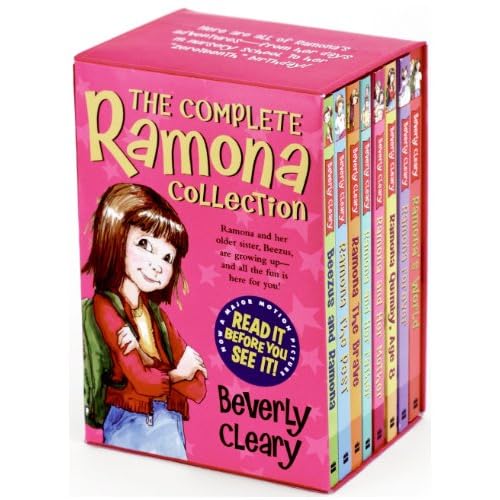
Do you see that? Ramona has been brought into the thousands. She certainly did not look like that when I was eating up every Ramona book I could get my hands on in elementary school. I knew exactly where she housed herself in the JC library. Up the ramp, through the door, hang a left, go past the desk, turn a paperback spinner, hit the aisle closest to the back wall, and on the bottom shelf. There she was. Ramona Quimby. Ramona Quimby - age 8. Beezus and Ramona. Heaven...yup...heaven. When I received my own Ramona books to pour over, shoot, you couldn't pull me from the couch. I. was. reading.
But I dunno...I didn't look like this Ramona. This new Ramona, all cool, kind, and with it. In fact, I'm not sure this picture would have lured me into the Ramona books and all her antics.
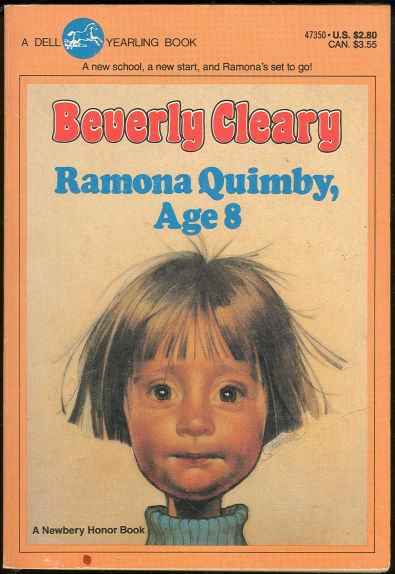
I related more with....well....this Ramona...

Look at that hair. Look at that face. That is Ramona. That is the Ramona that misunderstood her parents' swat with the spatula in the kitchen. That is the Ramona that tried to get her dad to stop smoking, wiped her sweater across her nose instead of getting a kleenex. I don't know if that Ramona up there in the pretty red sweater would be seen running her sleeve across her snotty nose. I don't know if that Ramona even produces snot.
I want Ramona to be in the lives of my kids. I want them to laugh at her, cry with her, and get frustrated at her parents with her - because she doesn't want to be nice to Willa Jean. I want my kids to see that Ramona and Beezus yell at each other, but they love each other too. I want them to see that Ramona's parents aren't perfect people - they make mistakes, but they love their kids and they are real. So, so, real.
Paint me nostalgic, but somethings are okay to leave in the imperfect stage. Somethings are okay to be, well, static- y like Ramona's hair...
Drew hasn't started on Ramona books yet, but he reads the new girl in town, oh yeah, you know who I'm talkin' about:
Junie B. Jones. Now look at that girl! She has some fly-aways! She is called a cheater pants. She says that May stinks. She gets caught in school because she hides in the closet. She is a rascal. She and Ramona? I bet would be BFFs if they were in the same decade - or same book.I know time marches on and I need to join the band, blah, blah, blah, but really? There are something about the covers of my old books. My books that are spine broken, cover bent, and worn that make me warm inside. I related to Ramona, as, I'm sure, Drew relates to Junie B. And, with respect to the mama bear stuff, I should just let my Ramona books go...but maybe I'll start reading them to Drew....tonight.
Thursday, January 7, 2010
Expectations: What To Expect...
Way back in the summer of 1993, I found out I was pregnant for the first time, with my oldest daughter. I was 21-years-old and knew nothing about pregnancy or infancy. My oldest sister mailed me her copy of What To Expect When You're Expecting. I was grateful. I read that book cover to cover, letting each word of wisdom, advice, and counseling sink deep into my bones.
One look at the cover told me it was time to grow up.

The woman on that cover says it all. Matronly, solemn, practical, pragmatic. She has no use for fashion or the stresses of the world or a good haircut. All she needs is her blue and mauve artificial flower arrangement, a pair of good, solid, gray flats and a wooden rocking chair in which to sit while she reads.
I could have recoiled and rebelled, refusing to take on the image. I was a typical college student of the 90s, experimenting with my identity through the newly formed grunge movement. Out was tailored and refined and melodic; in was bohemia and retro and cachophony. But this was no time to be watching reruns of the first season of The Real World. I was expecting a baby, and mothers were expected to be, well, mothers.
By the time I reach my last trimester and I was celebrating Christmas with my family in Florida, I was realizing my use for this book was quickly fading. Within six weeks I would no longer be expecting, but I would have an actual baby. My sister was quick on her feet again and gifted me with a copy of What To Expect The First Year.

Grateful for the new primer, I began reading it cover to cover, following the guidelines of how to diaper my new baby, how to dress her, how to bathe her, how to feed her, and on and on and on.
And so my education in parenting continued throughout my daughter's formative years. It wasn't until she was a preschooler that I needed to rely upon information outside of the What To Expect series. At that point, I stored away the books and saved them for the time when I became a parent again.
Fifteen years passed before I successfully carried a pregnancy beyond the first trimester again. I didn't even bother getting out Expecting. Mine was a high risk pregnancy from the get-go, and every question I had (if it was addressed in the book at all) was answered curtly with 'you should check with your doctor.' Somewhere around month 5 of my pregnancy, I realized I should get out The First Year and at least make sure I remembered how to swaddle a baby.
As I reread the book, I found myself in shock. What was this tome of archaic, authoritative, one-sided narrative? Where was the balance? Sure, I knew a lot had changed in 15 years in childbirth and hospital protocol, but the content that was shocking to me went far beyond whether to allow hospital staff to give your baby sugar water. It was the topic of where baby should sleep that startled me.
My husband and I had decided baby should sleep with us in our bedroom. The First Year couldn't have been more against this idea. Sure, it's fine at first when you have a newborn, but later, you better get that kid out of the room. True to What To Expect fashion, the book lists out a "number of serious problems" associated with co-sleeping. Less sleep for parents, less sleep for baby, less lovemaking, and more problems for everyone when the baby has to adjust later. The short solution given was this: get the baby out of your room quickly.
Really? Serious problems? And there's no way to avoid these problems? That's it? No discussion necessary, case closed, end of story?
The book goes on addressing the issue by saying that co-sleeping seems to work fine in other societies, but not this one. "In a society like ours, which stresses the development of independence and the important of privacy, co-sleeping is associated with a wide range of problems." Again with the laundry list: increased likelihood of sleep disorders, dental problems due to too-frequent and unnecessary nighttime feedings, stunting of emotional development, difficulty relating to peers, marital problems, and even behavior issues stemming from lack of boundaries between parents and children.
Is there no room for fostering intimacy between parents and children? Bonding as a couple with the baby? Extending the intimacy that brought the child there in the first place to include intimacy with the actual child? And what's up with valuing independence and privacy as the traits of utmost importance? I mean, sure, you want kids to be confident and individuals, but isn't a sense of family oneness important too?
By the chapter on month six, the book suggests that to reduce nighttime feedings, you go cold turkey and just let the baby cry it out. Oh my. I just couldn't agree with that.
As a parent, I have oftentimes lamented at why I chose to do things the way I did with my older daughter. Why didn't I consider cuddling more with her, why did I push her to achieve and succeed and be independent so much, why did I think that strict obedience was so important at such an early age? Rereading What To Expect The First Year made me realize that some portion of my approach came from following the advice that was given as gospel truth. It never occurred to me that there wasn't only one best way to parent. How you build a family differs with who you are and what you want your family to be like. What works for one family won't work for you. The decisions you make as a parent are an outgrowth of your personality, your partner's, and, to some extent, your children's.
I haven't taken the time to read the updated version of Expecting and The First Year. Maybe the content has changed with the times and is more balanced now. At least the cover art is a little more realistic. (But they still hold on to that quilted background, like quilting is a necessary part of the transformation of woman to mother.)


Regardless of what the authors of What To Expect have decided their advice will be at this point, I think I've learned a more important lesson through my years as a parent. Take every piece of information with a grain of salt.
One look at the cover told me it was time to grow up.

The woman on that cover says it all. Matronly, solemn, practical, pragmatic. She has no use for fashion or the stresses of the world or a good haircut. All she needs is her blue and mauve artificial flower arrangement, a pair of good, solid, gray flats and a wooden rocking chair in which to sit while she reads.
I could have recoiled and rebelled, refusing to take on the image. I was a typical college student of the 90s, experimenting with my identity through the newly formed grunge movement. Out was tailored and refined and melodic; in was bohemia and retro and cachophony. But this was no time to be watching reruns of the first season of The Real World. I was expecting a baby, and mothers were expected to be, well, mothers.
By the time I reach my last trimester and I was celebrating Christmas with my family in Florida, I was realizing my use for this book was quickly fading. Within six weeks I would no longer be expecting, but I would have an actual baby. My sister was quick on her feet again and gifted me with a copy of What To Expect The First Year.

Grateful for the new primer, I began reading it cover to cover, following the guidelines of how to diaper my new baby, how to dress her, how to bathe her, how to feed her, and on and on and on.
And so my education in parenting continued throughout my daughter's formative years. It wasn't until she was a preschooler that I needed to rely upon information outside of the What To Expect series. At that point, I stored away the books and saved them for the time when I became a parent again.
Fifteen years passed before I successfully carried a pregnancy beyond the first trimester again. I didn't even bother getting out Expecting. Mine was a high risk pregnancy from the get-go, and every question I had (if it was addressed in the book at all) was answered curtly with 'you should check with your doctor.' Somewhere around month 5 of my pregnancy, I realized I should get out The First Year and at least make sure I remembered how to swaddle a baby.
As I reread the book, I found myself in shock. What was this tome of archaic, authoritative, one-sided narrative? Where was the balance? Sure, I knew a lot had changed in 15 years in childbirth and hospital protocol, but the content that was shocking to me went far beyond whether to allow hospital staff to give your baby sugar water. It was the topic of where baby should sleep that startled me.
My husband and I had decided baby should sleep with us in our bedroom. The First Year couldn't have been more against this idea. Sure, it's fine at first when you have a newborn, but later, you better get that kid out of the room. True to What To Expect fashion, the book lists out a "number of serious problems" associated with co-sleeping. Less sleep for parents, less sleep for baby, less lovemaking, and more problems for everyone when the baby has to adjust later. The short solution given was this: get the baby out of your room quickly.
Really? Serious problems? And there's no way to avoid these problems? That's it? No discussion necessary, case closed, end of story?
The book goes on addressing the issue by saying that co-sleeping seems to work fine in other societies, but not this one. "In a society like ours, which stresses the development of independence and the important of privacy, co-sleeping is associated with a wide range of problems." Again with the laundry list: increased likelihood of sleep disorders, dental problems due to too-frequent and unnecessary nighttime feedings, stunting of emotional development, difficulty relating to peers, marital problems, and even behavior issues stemming from lack of boundaries between parents and children.
Is there no room for fostering intimacy between parents and children? Bonding as a couple with the baby? Extending the intimacy that brought the child there in the first place to include intimacy with the actual child? And what's up with valuing independence and privacy as the traits of utmost importance? I mean, sure, you want kids to be confident and individuals, but isn't a sense of family oneness important too?
By the chapter on month six, the book suggests that to reduce nighttime feedings, you go cold turkey and just let the baby cry it out. Oh my. I just couldn't agree with that.
As a parent, I have oftentimes lamented at why I chose to do things the way I did with my older daughter. Why didn't I consider cuddling more with her, why did I push her to achieve and succeed and be independent so much, why did I think that strict obedience was so important at such an early age? Rereading What To Expect The First Year made me realize that some portion of my approach came from following the advice that was given as gospel truth. It never occurred to me that there wasn't only one best way to parent. How you build a family differs with who you are and what you want your family to be like. What works for one family won't work for you. The decisions you make as a parent are an outgrowth of your personality, your partner's, and, to some extent, your children's.
I haven't taken the time to read the updated version of Expecting and The First Year. Maybe the content has changed with the times and is more balanced now. At least the cover art is a little more realistic. (But they still hold on to that quilted background, like quilting is a necessary part of the transformation of woman to mother.)


Regardless of what the authors of What To Expect have decided their advice will be at this point, I think I've learned a more important lesson through my years as a parent. Take every piece of information with a grain of salt.
Labels:
family,
Good Reads,
motherhood,
parenting choices,
pregnancy
Subscribe to:
Posts (Atom)